Interlaken Treaty Organisation forces are expected to return to active duty in Western Gallia later this week after President Arnaud of Belmonté dropped his opposition to continuing airstrikes against the Solarian regime in Torrence.
Arnaud had been facing calls to change his strategy in dealing with the prolonged conflict following the intervention of his predecessor Amaury Debussy. In a major interview on Saturday while on a visit to Chaumont in Serenièrre, former President Debussy said that Arnaud was ‘allowing evil to reign’ by not taking aggressive action to tackle the remaining forces loyal to the so-called ‘Pope of Padania’ in Torrence. He admitted he had ‘got it wrong’ in 2016 when, whilst campaigning against Arnaud for a second term, he had tried to resist further airstrikes saying at the time that military force was not ‘winning the war’.
Responding to the charge that he has not dealt effectively with the crisis over recent months, President Arnaud said he had consulted with foreign capitals over the last few days and had decided to allow airstrikes to resume – hoping to force a major breakthrough in the ten-year siege. He is thought to have recommended a major escalation in attacks – stating that he believed it was important that the strategy ‘worked, not merely happened’ and off-the-record briefing from members of his administration stressed that his opposition to further strikes had been because other ITO nations were ‘not prepared to deliver them at the scale and pace required to be assured of military superiority’.
Experts claim that the Solarian regime has significantly strengthened its hand during the year long break in strikes and that the ITO alliance faces a difficult set of circumstances as the summer draws to an end.

Around 2.5 million people are still thought to be held by the regime in Torrence, its last stronghold in the region. ITO forces managed to make significant gains through the use of airstrikes in the early parts of the conflict – minimising the fanatical regime’s ability to use force and significantly limiting its range and scope.
Belmonté, one of the regions largest military forces and as the major ITO state affected by the conflict, took a lead in military action. The Padanian provinces were liberated in late 2009, before a further escalation took place in 2011 – when Torrence attacked Nicosia in the Long Sea. As a result of the setbacks, but also as The East Padanian government was created in Vlaanderen, Amaury Debussy called a set of summits designed to create a unified response in an attempt to end the conflict. In 2012 an extended maritime and air exclusion barrier was implemented, having been supported by Prime Minister Ludvig Fedorov, but calls for renewed airstrikes were rejected by ITO chief Jensen Hendentenberg. Villesen responded by attempting to negotiate directly with the Solarian regime, but despite initially creating lines of communication, Torrence refused to enter into talks. Communication was lost in 2013 and was never returned in what has been described as a ‘dark silence’. Debussy later lost the 2016 presidential election to Arnaud, who campaigned on bringing attempts to bring the regime to the table to an end, and resume military attacks.


On Wednesday ITO forces will move into a base at Emmeloord in the Free States Union and will be supported by additional air support forces from Helgoland in Eiffelland. President Artamova is yet to confirm whether Polascianan forces based at Belev will join in with the renewed attacks, with forces still serving the maritime exclusion zone in the Long Sea as the Federal Republic’s key contribution in the conflict. Presidential contender and Federal Council leader Ivan Tattar however has called for Polasciana to join ITO action – saying in a speech on Sunday that “Polasciana should provide solidarity and support in any way we can in this campaign. If we do not provide combat forces, then we should offer logistical support from our bases in Belev. This is a crisis for our whole continent and it must come to an end.”
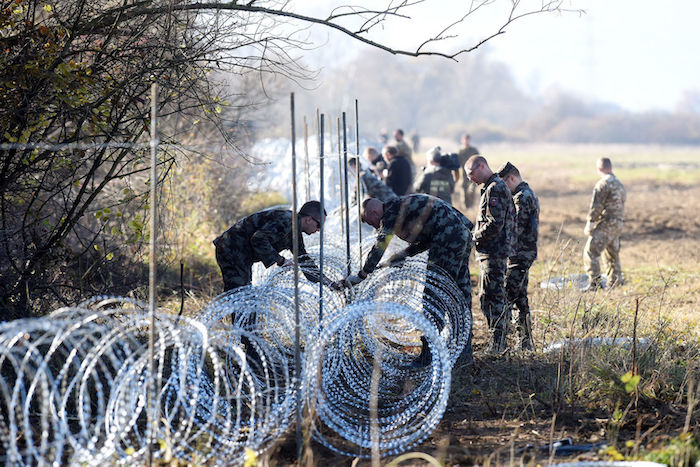
The East Padanian government in Vlaanderen, which provides trusteeship over the Lierland, said that it welcomed the renewed focus on beating the Solarian regime in Torrence. A spokesperson for the administration said that an end to the conflict was ‘so badly overdue and all and any action is required.’ The Elementist regime has had a stronghold over Torrence since 2012, when it doubled down on holding its territory which has since been contained to the capital and surrounding areas including Ramsel. The regime maintains a heavily militarised outer border – which spans 30km deep at its thinnest point. Since 2012, only seventeen people have been found trying to escape on the Eastern border – at each point the regime has responded with a military retaliation, prompting rumours that Torrence heavily monitors foreign news.
ITO’s leading commander, Hendentenberg, will meet with military chiefs across Gallia over the coming days.