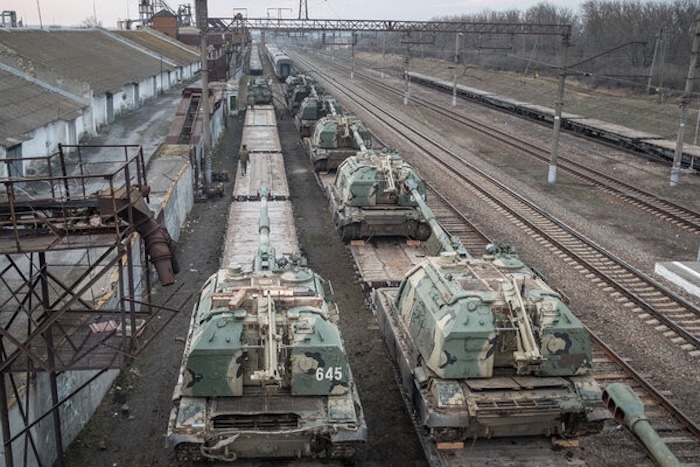
Tonight there is growing concern over the increasing build up of Kadiki troops on the border of the Boli state of Rascasia in Eastern Sarvaria. In scenes reminiscent of those in late 2008 when similar movements led to the annexation of the Kolmar territory, the presence of military forces are increasing outside the city of Kolmonia – itself about 150 kilometers from Osh, the capital of the Rascasian territory.
Ivar, which has exercised similar deployments in the past, has said the move is part of ‘routine training’, and that “no threat” was posed by the forces, given the country had “no interest in military action with another nationstate”. The statement however has failed to calm nerves growing across the globe, with fears of further confrontation. Kadikistan last conducted a mobilisation of this kind on its more southern Jafna border in 2016, and does regularly train troops during winter months. But the scale of the deployment, and its strategic position – a first – has raised additional concern, with many intelligence experts claiming that the force’s size presents “significant risk” of an “impending” military invasion.
Rascasia however is unlikely to be defended in the same way as other Boli states, such as Jafna and Racaria, have been in the past by international actors. This is largely due to its lack of important and critical natural materials. Instead the state most closely resembles Kolmar, which was effectively sacrificed by ITO and other states in order to protect Jafna during the 2008 stand-off which saw it occupied by Kadiki forces, in its more populous focus. The city of Osh is one of the biggest population centres in the region – and its loss would resemble a huge shift in the composition of Boliatur – a nationstate which has struggled with its identity, security and governance since its formation upon the withdrawl of Belmish troops in the 1990s. The President of Belmonté, Bastien Arnaud, has already said that “costly” military action in the region would not necessarily be in his own country’s interest, but has not ruled out the further deployment of forces. ITO forces, under Villesen’s command, are already stationed in the region, after the breakaway of Sikandara from the Boli state in 2012.
Karasicena was previously utilised to back-channel with the Kadiki state in both circumstances, but the move proved controversial and continues to be a major political scandal in Polasciana. It is unlikely that either President Tattar or Prime Minister Serbin would offer any support in the issue to other states, unless a humanitarian mission was organised, or it was called on to do so by ITO. Interlaken has involved Polascianan leaders in similar circumstances, most recently over the ongoing crisis in the Lierland. Cordial relations remain with communitarian Kadikistan however, which could prove useful in surfacing the country’s goals and aims.
Arnaud and other ITO leaders are expected to be kept abreast of the situation as Kadiki troops continue their journey towards Kolmonia, which itself may be used as a red line for further movements before a warning or further concern is raised with Ivar, either directly or indirectly. ITO and other regional forces are already stretched, facing Gallian security threats, but also the potential for tensions at the meeting point of Himyar and Savannah in Bismallah to escalate, as well as concerns with the stability of the Sortain Territories in Northern Toyou. President Tattar is thought to be following developments closely.