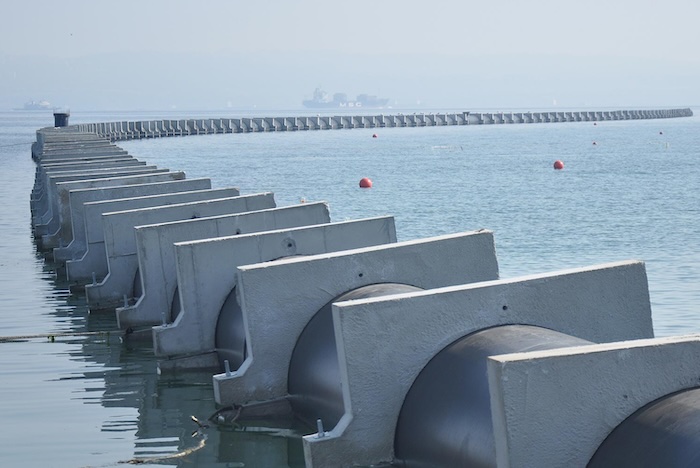
The government has hailed the end of construction on the Northern Tidal Barrier a “major milestone” in defending the country from coastal erosion and worsening weather conditions.
Initially proposed in 2008, construction on the barrier – which runs from the southern tip of the Isisny Islands through to Rusa in Béspura – has taken some thirteen years in what has been an embarrassment and political headache for the government. Funded by the 2010 Environmental Protection Programme, the scheme has been developed in partnership with engineers from Eiffelland and the United Republic – but has come at a major cost. Initially budgeted to cost some kR20bn, the final bill is expected to have escalated to well over 180bn.
Annual worsening storms have made its construction increasingly important with Béspura’s governor Akim Veselov and the Chief Council woman of the Isisny Islands Anna Rico pushing for further expansion of the scheme. Evgeny Almarav, the responsible minister, re-committed to doing “everything possible” to speed up construction back in 2021 – and today announced that the government intended to commit to a second phase of construction in the southern islands by 2028.
The barrier utilises the latest technology to control water levels in the Isisny Bay – and acts to slow down tidal currents between its islands and the mainland. Particularly strong and harsh conditions are often created by the thermal effect created by the meeting point of the Great Sea, Schnet Coast and Donneyt Bay just off the country’s shore-land – an issue that has also blighted communities on Eiffelland’s Retalian coast.
An extended barrier was first proposed as part of the controversial Energy and Economic Futures Bill which was debated in 2012, but failed to gain approval – causing several political crises. But at a press conference in Rusa earlier today Almarav said that the government saw the infrastructure as “critical”. “We don’t have a choice. Ultimately coastal erosion becomes everyone’s problem. So we need to act. The government is clear about that and we believe there is the necessary support across the Federal Executive to fund an extension – which would see another 100 kilometers of the barrier built over the next four years.”
But critics say that the government has not considered several key factors which could further delay construction. In particular, the deeper trench of water between the southern islands and the mainland coast – as well as challenging currents which could make it treacherous for workers. “The simple fact is the government launched into this scheme without understanding what they were building in the first place – to do so again now would be reckless given the extensive costs of what we now have today” said Devyan Kiminishilli, a professor of engineering at Kiasé College.
Political support will now be sought by the government amongst its coalition partners, with any agreement likely to be signed as part of budget negotiations now underway and expected to be presented in a final Finance Bill in October.